
Episode 13 – WAR
- Mar 5
- 4 min read

War is one of those subjects humanity keeps pretending it has evolved beyond. We like to imagine that modern civilization, with its diplomacy, global institutions, and carefully worded treaties, has somehow grown past the brutal instincts that shaped most of human history. But every generation eventually runs into the same uncomfortable truth: conflict never really left. It simply changed uniforms.
That realization sits at the center of Episode 13 of the Middle Minded Podcast, where Dave and Peter take on one of the oldest and most difficult subjects in human society: war. The conversation begins with the current conflict involving Iran and the political decisions surrounding President Trump that helped ignite it. Like nearly every geopolitical event in the modern era, the conflict instantly fractured public opinion. Some Americans see decisive action and necessary strength. Others see reckless escalation and unnecessary risk.
But the deeper conversation in this episode is not about which side of the political aisle has the better argument. It’s about a more fundamental question that civilization has wrestled with for thousands of years: what role does war actually play in the world we live in?

To explore that question, the conversation pulls back from modern politics and looks at something older than governments themselves: the nature of life. In nature, survival is rarely peaceful. A lion hunts because it must. If it fails to hunt, it starves. Trees compete for sunlight, stretching higher while choking out the smaller growth beneath them. Blackberry vines creep across open ground and slowly overtake everything in their path. The natural world is not guided by diplomacy or negotiation. It operates through competition, adaptation, and survival.
In that sense, conflict is not some strange human invention. It is woven into the fabric of life itself.
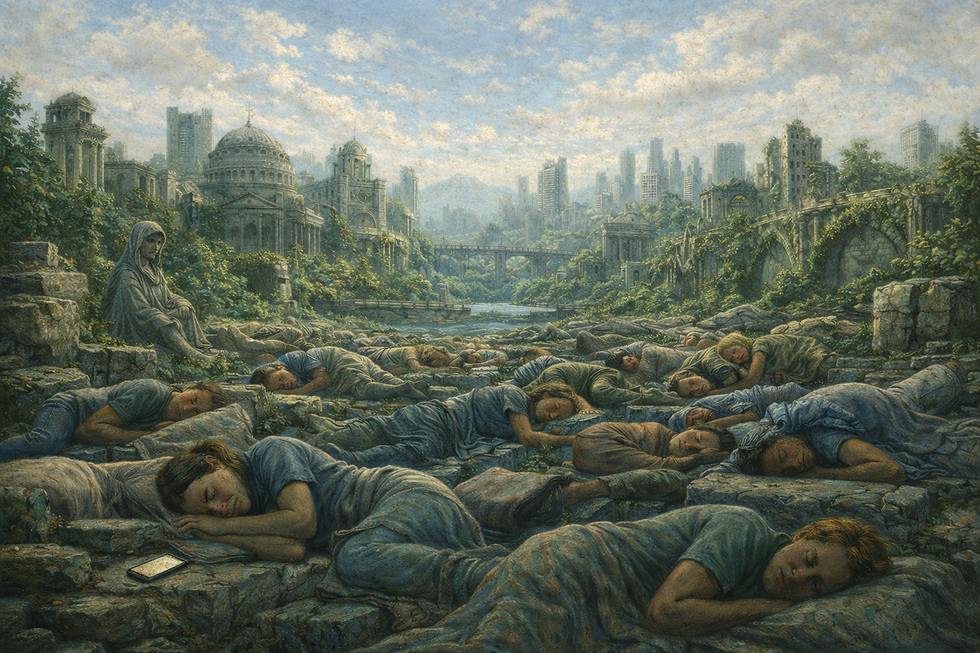
Civilization attempts to manage this reality, but it does not erase it. Nations compete for resources, territory, influence, and security. When those interests collide, history shows that negotiation sometimes succeeds, but sometimes it fails. When it fails, war returns to the stage.
Dave and Peter wrestle openly with the tension between these realities. On one hand, modern societies understandably want to avoid war whenever possible. The destruction it causes is enormous, and the cost is paid in lives, families, and generations of consequences. On the other hand, history also shows that refusing to confront aggression does not always lead to peace. Sometimes it simply encourages the next challenge.
One of the more provocative moments in the episode comes when Peter makes a blunt comparison: war is a lot like sex. It’s not something you should enter casually, and it’s certainly not something you begin if you already know you’re going to pull out halfway through. The point of the analogy is not shock value. It is a reminder that war, once started, carries enormous momentum. Half measures, hesitation, and unclear objectives often prolong conflict rather than end it.

History is full of wars that dragged on precisely because the participants were unwilling to fully commit to victory while also being unwilling to fully walk away. When nations step into conflict, they must do so with clarity about the stakes, the goals, and the cost of both action and inaction.
The episode also moves into a culturally charged topic that modern societies struggle to discuss honestly: the relationship between violence and manhood. For most of human history, men were expected to be the protectors of families, communities, and nations. Strength, courage, and the willingness to confront danger were not merely admired traits; they were essential survival qualities.
In today’s world, those traditional roles are being reexamined. Modern values have reshaped expectations around gender, equality, and social responsibility. As a result, the discussion inevitably turns toward one of the most controversial questions of modern military policy: should women be drafted and placed in the same combat roles as men?
The debate is complex. Many women have served with extraordinary bravery and capability in military roles around the world. At the same time, combat environments often push the limits of human physical endurance and strength. The question is not simply about opportunity, but about the realities of warfare itself. Dave and Peter do not attempt to deliver a final verdict on the issue, but they do argue that the conversation deserves honesty rather than slogans.

Beyond the cultural questions, the episode also explores the strategic nature of modern warfare. War today rarely unfolds as chaotic battlefield clashes alone. Instead, it resembles a global chess match. Nations maneuver through alliances, sanctions, intelligence operations, cyber warfare, and economic pressure long before a single missile is launched. Every move is calculated, and every move sends signals to allies and adversaries alike.
In this environment, the conflict with Iran becomes part of a larger strategic picture involving multiple world powers. Decisions made in Washington ripple outward to Moscow, Beijing, and beyond. The stakes extend far beyond a single battlefield. They touch energy markets, regional stability, and the balance of power across entire continents.
This reality raises another sobering question: are we witnessing a contained conflict, or the early movements of a larger geopolitical shift?
Despite the disagreements and tensions explored throughout the episode, one central idea emerges by the end of the discussion. A nation deeply divided against itself weakens its ability to respond to external challenges. Political disagreement is natural in a free society, and debate is part of the democratic process. But when serious global conflicts emerge, history shows that unity—at least around core national interests—can become a critical factor.

The purpose of this episode is not to glorify war or treat it as inevitable destiny. Instead, it attempts to confront the subject honestly. War has been a constant presence throughout human history, and pretending it no longer exists does not make the world safer. Understanding its causes, its consequences, and its realities may be the first step toward navigating it responsibly.

Civilization will always strive for peace. That aspiration is one of humanity’s greatest achievements. But history suggests that peace is rarely preserved by wishful thinking alone. It requires strength, clarity, and sometimes difficult choices about when to stand firm and when to step back.
War may be one of humanity’s oldest problems.
But ignoring it has never been a solution. https://youtu.be/vfjx9aWbHSo


Comments